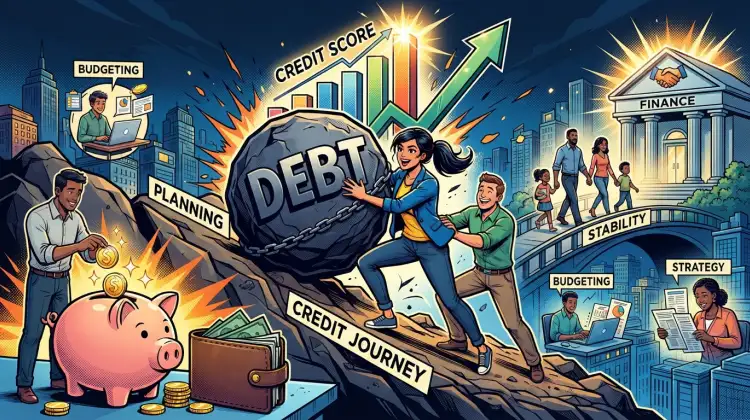
Your credit score is one of the most consequential numbers in your financial life. It influences whether you qualify for a mortgage, auto loan, or credit card, and it determines the interest rate you pay on that debt. In the United States, the most widely used scoring model is the FICO Score, which ranges from 300 to 850. VantageScore, a competing model used by many lenders and free credit monitoring services, uses the same 300–850 range. Understanding what drives these scores is the first step toward improving them.
Understand What Actually Goes Into Your Score
FICO calculates scores using five categories of information from your credit reports at Equifax, Experian, and TransUnion. The approximate weights are:
- Payment history (35%): Whether you pay on time, every time.
- Amounts owed (30%): How much of your available credit you are using, known as credit utilization.
- Length of credit history (15%): How long your accounts have been open.
- New credit (10%): Recent applications and newly opened accounts.
- Credit mix (10%): A blend of revolving credit (cards) and installment loans (auto, student, mortgage).
Because payment history and amounts owed together account for roughly 65% of your score, those two areas deserve the most attention.
1. Get Your Reports and Dispute Errors
You are entitled to a free credit report every week from each of the three national credit bureaus through AnnualCreditReport.com, the only federally authorized source. Review all three reports carefully. The Consumer Financial Protection Bureau (CFPB) has found that a meaningful share of consumers identify at least one error, and errors that lower your score can often be removed through a dispute.
Look for accounts that are not yours, late payments reported inaccurately, balances that are wrong, or duplicate collections. File a dispute directly with the bureau online or by mail. Under the Fair Credit Reporting Act, the bureau generally must investigate and respond within 30 days. Keep documentation of everything you submit.
2. Pay Every Bill on Time
Payment history carries the most weight, and a single payment that is 30 days late can stay on your report for seven years. Set up autopay for at least the minimum due on every account so a busy month never turns into a derogatory mark. If you are already behind, bring the account current as quickly as possible — recent late payments hurt more than older ones, and the impact fades over time.
If you have struggled with payments, contact your lender about hardship programs before the account is charged off or sent to collections. Many issuers offer forbearance or modified payment plans that keep the account in good standing.
3. Lower Your Credit Utilization
Credit utilization is the second-largest factor. It is calculated by dividing your balances by your total credit limits, both per card and across all cards. A common guideline is to keep utilization below 30%, but consumers with the highest scores often stay under 10%.
Practical ways to reduce utilization:
- Pay down balances, starting with the card that is closest to its limit.
- Make multiple payments during the month so the balance reported to the bureaus is lower.
- Ask issuers for a credit limit increase — this raises your available credit without new debt, though it may trigger a soft inquiry.
- Avoid closing old cards, since doing so reduces total available credit and shortens your history.
4. Be Strategic About New Credit
Each hard inquiry from a credit application can trim a few points, and a flurry of applications signals risk to lenders. Rate shopping for a mortgage or auto loan is treated differently: FICO generally counts inquiries within a 14- to 45-day window as a single inquiry, depending on the version of the model, so it is smart to cluster those applications.
If you are rebuilding credit, a secured credit card — which requires a cash deposit — or a credit-builder loan from a community bank or credit union can establish positive history. Use the card lightly, pay the statement balance in full, and let the account age.
5. Give It Time and Monitor Progress
Credit improvement is a marathon, not a sprint. Negative items like late payments, collections, and bankruptcies have the greatest impact when they are new and gradually matter less. Most scoring damage from a single 30-day late payment eases within a year or two, while a Chapter 7 bankruptcy can remain on your report for up to 10 years.
Check your scores regularly through a free service from your bank or a nonprofit credit counselor. Watching the trend line — not day-to-day fluctuations — tells you whether your strategy is working. If you feel overwhelmed, a nonprofit counselor affiliated with the National Foundation for Credit Counseling can review your situation at low or no cost.
What to Remember
Improving your credit score comes down to a handful of consistent habits: pay every account on time, keep balances low relative to your limits, dispute inaccuracies on your reports, apply for new credit sparingly, and let your accounts age. There is no legitimate shortcut that removes accurate negative information early, and anyone promising to do so for a fee should be treated with suspicion. Focus on the factors you control, and your score will follow.