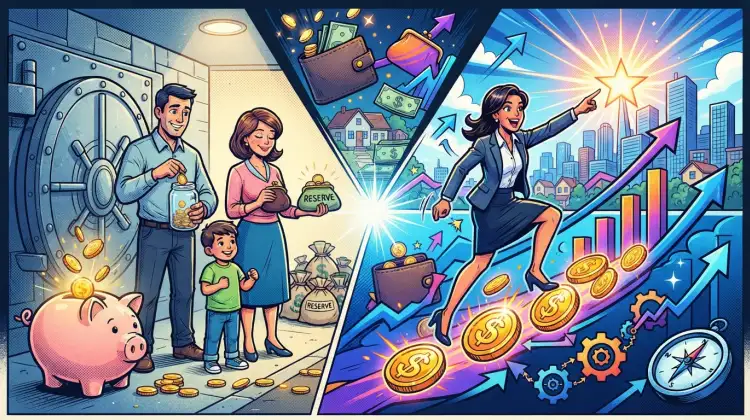
The difference between saving and investing comes down to three things: purpose, risk, and time. Saving means putting money somewhere safe and liquid so you can access it soon — an FDIC-insured savings account, a money market account, or a certificate of deposit (CD). Investing means buying assets such as stocks, bonds, or mutual funds with the expectation that they will grow in value over years or decades, accepting that their value can also fall. Both belong in a healthy financial plan, but they do different jobs. Confusing the two is one of the most common — and most expensive — mistakes in personal finance.
What Saving Actually Does
Saving is about preserving capital and keeping it available. When you deposit money at a bank or credit union, you are not trying to earn a high return; you are buying safety, liquidity, and peace of mind. Deposit accounts are insured by the FDIC (banks) or NCUA (credit unions) up to $250,000 per depositor, per institution, per ownership category, so the principal is protected even if the institution fails.
The trade-off is that savings rarely keep pace with inflation. If your savings account earns 4% while inflation runs at 3%, your real return is roughly 1%. In years when savings rates sit near 0.5% and inflation is higher, cash quietly loses purchasing power. That is acceptable for money you will need soon, but it is a poor strategy for money you will not touch for 20 years.
Use savings for:
- Emergency funds — three to six months of essential expenses, held in an easily accessible account.
- Short-term goals — a car purchase in 18 months, a home down payment in two years, a wedding, or a vacation.
- Sinking funds — predictable irregular costs like car repairs, insurance premiums, or holiday gifts.
- Near-term cash flow — your checking buffer and any bill you will pay within the next 12 months.
A practical rule: if you need the money within about three to five years, keep it in savings or another low-volatility, insured vehicle. A stock market decline of 20% is a temporary setback for a retirement account but a genuine crisis for a down payment due next spring.
What Investing Actually Does
Investing is about growth. You exchange liquidity and certainty for the chance to earn a higher long-term return. Historically, the S&P 500 has returned roughly 10% per year on average before inflation over long multi-decade periods, though individual years range from sharply negative to strongly positive. That average is the reward for tolerating volatility and staying invested through downturns.
Common investment vehicles include:
- Stocks — ownership shares in companies, available individually or through index funds and ETFs.
- Bonds — loans to governments or corporations that pay interest and typically carry less volatility than stocks.
- Mutual funds and ETFs — pooled portfolios that provide instant diversification at low cost.
- Retirement accounts — 401(k)s and IRAs, which offer tax advantages that amplify long-term compounding.
Two forces make investing powerful. The first is compounding: a 7% average annual return doubles money roughly every 10 years. The second is time: the longer your horizon, the more likely a diversified portfolio recovers from any single bad year. A 25-year-old investing for retirement has decades to ride out market cycles; a 60-year-old saving for a car next year does not.
Investing also carries real risk. Markets fall, individual companies fail, and fees erode returns. That is why diversification, low costs, and a time horizon measured in years — not months — matter more than picking the perfect fund.
Saving vs Investing: A Side-by-Side Comparison
- Primary goal: Saving protects money; investing grows it.
- Risk of loss: Savings is insured and stable; investments can lose value.
- Liquidity: Savings is available immediately; investments may take days to sell and settle.
- Typical return: Savings earns a modest interest rate; investments target higher long-term returns.
- Time horizon: Savings suits goals under about three to five years; investing suits goals 10+ years away.
- Inflation: Savings may lose purchasing power; a diversified portfolio aims to outpace inflation over time.
How to Split Your Money Between the Two
You do not have to choose. Most people should do both, in a deliberate order.
- Build a starter emergency fund. Aim for $1,000 to one month of expenses in a high-yield savings account.
- Capture any employer 401(k) match. This is an immediate, guaranteed return that no savings account can match.
- Pay down high-interest debt. Credit card balances at 20%+ APR cost more than most investments reliably earn.
- Finish your emergency fund. Three to six months of essential expenses, held in cash.
- Invest for the long term. Fund an IRA or increase your 401(k) contribution, prioritizing low-cost, diversified funds.
- Save for medium-term goals in parallel. Keep down payments and other 3–5 year goals in CDs or savings, not stocks.
Automate both sides. A recurring transfer to savings on payday and an automatic contribution to your retirement account remove emotion from the process and keep you consistent.
Common Mistakes to Avoid
- Investing your emergency fund. A market drop plus a job loss is a worst-case combination.
- Leaving long-term money in cash. Over 30 years, inflation can cut a savings account's purchasing power substantially.
- Chasing returns. High advertised yields often come with risk or restrictions you may not want.
- Ignoring fees. A 1% annual fee can reduce a portfolio's ending value by a meaningful amount over decades.
- Panic selling. Locking in losses during a downturn turns a temporary decline into a permanent one.
The Short Version
Saving and investing are complementary tools, not competitors. Saving protects the money you will need soon and keeps it liquid and insured. Investing grows the money you will not need for years, accepting short-term volatility in exchange for long-term compounding. Match each dollar to the right job based on your time horizon: cash for near-term needs and emergencies, investments for retirement and other goals a decade or more away. Get the order right — emergency fund, employer match, high-interest debt, then long-term investing — and you will avoid the most common and costly mistakes.







