If you have ever checked your credit score and wondered why it moved, the answer often comes down to one number: your credit utilization ratio. It is the second most influential factor in FICO scoring models, accounting for about 30% of your score, and it is also one of the few scoring inputs you can change within a single billing cycle. This guide explains how the ratio works, how issuers and the credit bureaus see it, and what you can realistically do to keep it in a healthy range.
What the Credit Utilization Ratio Actually Measures
Your credit utilization ratio is the percentage of your available revolving credit that you are currently using. It is calculated by dividing your total balances on revolving accounts, such as credit cards and lines of credit, by your total credit limits on those same accounts.
For example, if you have two credit cards with limits of $5,000 and $3,000, your total available credit is $8,000. If your balances are $1,200 and $600, your total balance is $1,800. Divide $1,800 by $8,000 and you get 0.225, or a 22.5% utilization ratio.
Two important details:
- Installment loans do not count. Auto loans, mortgages, and student loans are not included in the utilization calculation because they are not revolving credit.
- Both overall and per-card ratios matter. FICO and VantageScore consider your aggregate utilization across all cards and your utilization on each individual card. A maxed-out card can hurt even if your overall ratio looks fine.
Why the Ratio Carries So Much Weight
Lenders use credit scores to estimate the probability that a borrower will miss a payment. Utilization is treated as a proxy for how heavily you rely on borrowed money. Consumers who routinely use a large share of their available limits are statistically more likely to struggle with repayment, so the scoring models penalize high ratios.
The widely cited thresholds come from FICO guidance and industry analysis:
- Below 10%: excellent for scoring purposes
- 10% to 29%: generally good
- 30% to 49%: can begin to lower scores
- 50% and above: typically a meaningful negative
- 100% or over: severely damaging, including balances above the limit
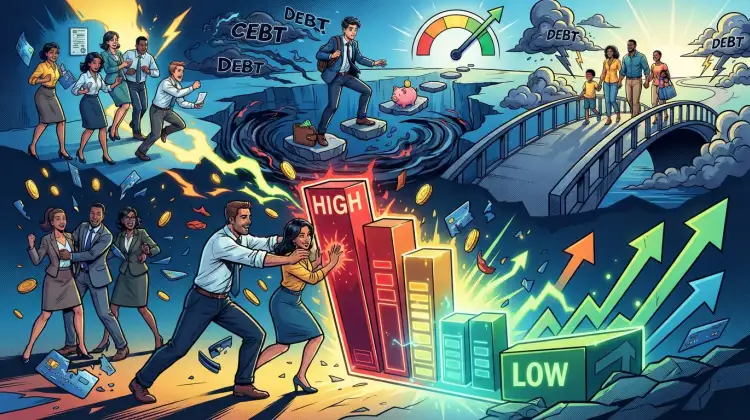
There is no single cliff edge. Scores tend to decline gradually as utilization rises, which means small improvements can produce small gains even if you cannot reach a low single-digit ratio.
How the Timing Works: Statement Dates and Reporting
Card issuers generally report your balance to the three nationwide credit bureaus, Equifax, Experian, and TransUnion, once a month, usually on or near your statement closing date. That reported balance, not your balance on any random day, is what the scoring models see.
This creates a practical opportunity. If you pay down a card before the statement closes, the lower balance is what gets reported, and your score can reflect it within weeks. Paying after the statement closes still avoids interest but may not help your reported utilization until the following cycle.
If you are preparing for a mortgage or auto loan application, many loan officers recommend paying balances down several weeks before the lender pulls your credit so the updated figures have time to reach the bureaus.
Practical Ways to Lower Your Utilization Ratio
Pay down the highest-utilization card first
Because per-card utilization is scored separately, reducing a balance on a nearly maxed-out card usually moves your score more than spreading the same payment across several cards. This differs from the debt avalanche method, which targets the highest interest rate first; for score purposes, target the highest ratio.
Ask for a credit limit increase
If your income and payment history support it, requesting a higher limit lowers your ratio without changing your spending. Be aware that some issuers perform a hard inquiry, which can cause a small temporary dip, and that a higher limit can be a temptation to spend more.
Make multiple payments in a month
If you use a card heavily for rewards or business expenses, paying it down mid-cycle and again before the statement closes keeps the reported balance low. Some issuers even allow several payments per month at no cost.
Keep old accounts open
Closing a card reduces your total available credit and can raise your ratio immediately. Unless an annual fee outweighs the benefit, keeping a long-standing account open with a small recurring charge is usually the better scoring move.
Consider a credit builder or secured card
If your only card is near its limit, adding a secured card with a deposit increases your total available credit. Used responsibly, this can lower your overall ratio while building payment history.
Common Misunderstandings
- Carrying a balance does not help your score. The persistent myth that you must carry debt to build credit is false; paying in full each month is better for both your score and your wallet.
- Zero percent utilization is not automatically best. Some models treat a small reported balance as a sign of active, responsible use. A ratio between 1% and 9% is generally ideal.
- Utilization has no memory. Unlike late payments, which stay on your report for seven years, utilization is recalculated each cycle, so past high balances stop affecting your score once new data reports.
What to Remember
Your credit utilization ratio is the share of your revolving credit limits that you are using, and it accounts for roughly 30% of a FICO score. Keep both your overall and per-card ratios below 30%, aim for under 10% if you are applying for new credit, and remember that the balance reported on your statement date is the one that counts. Because the ratio resets every month, it is one of the fastest credit score levers available to you. Pay down the highest-ratio card first, consider a limit increase, and avoid closing old accounts unnecessarily.