If you're juggling multiple credit cards, personal loans, or medical bills, you've probably run into two competing payoff plans: the debt snowball and the debt avalanche. Both require the same core commitment — pay the minimum on every account, then throw every extra dollar at one target balance until it's gone. The difference is which balance you attack first, and that choice affects both your total interest cost and your odds of sticking with the plan.
Here's how each method works, what the research says about them, and how to pick the one that fits your situation.
How the Debt Snowball Works
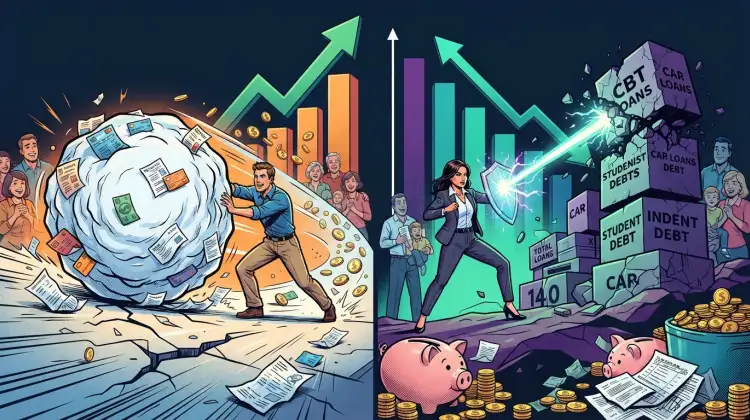
With the snowball, you order your debts from smallest balance to largest, regardless of interest rate. You pay minimums on everything, then direct all surplus cash to the smallest debt. When it's paid off, you roll that payment into the next-smallest balance, and so on. Your minimum payment total never shrinks — it just gets concentrated on fewer accounts over time.
Example: You owe $400 on a store card at 26% APR, $2,100 on a Visa at 22%, and $7,500 on a personal loan at 12%. The snowball targets the $400 store card first. Once it's gone, that payment plus the freed-up minimum goes to the Visa.
The appeal is behavioral. Knocking out an entire account in a few weeks or months delivers a visible win, which matters because payoff plans fail more often from discouragement than from bad math.
How the Debt Avalanche Works
The avalanche orders debts from highest interest rate to lowest. You still pay minimums everywhere, but the extra money goes to the most expensive debt first. When that's cleared, you move to the next-highest rate.
Using the same example, the avalanche attacks the 26% store card first, then the 22% Visa, then the 12% loan — which happens to match the snowball order here. The methods diverge when a large balance carries a high rate: the avalanche targets it immediately, while the snowball may leave it untouched for months.
Because interest accrues on the highest-rate balance, the avalanche almost always costs less in total interest and often pays off the full debt load sooner.
The Math vs. the Motivation
The interest savings from the avalanche depend on how different your rates are and how large the balances are. If you owe $18,000 across five accounts with rates ranging from 9% to 27%, the avalanche might save several hundred to over a thousand dollars compared with the snowball, and shave a few months off the timeline. If all your rates are within a point or two of each other, the two methods produce nearly identical results — in that case, pick whichever keeps you motivated.
There's real research behind the behavioral argument. A widely cited study published in the Journal of Consumer Research found that consumers who focused on paying off one account at a time — particularly smaller balances — were more likely to eliminate their debts than those who spread extra payments across accounts. The researchers attributed this to the motivational boost of closing an account entirely.
So the honest summary: the avalanche is the mathematically optimal choice, and the snowball is often the psychologically optimal one. Neither is wrong. The best plan is the one you'll actually finish.
Which Strategy Should You Choose?
Consider the avalanche if:
- One or more accounts carry dramatically higher APRs (for example, a 29% store card next to a 6% federal student loan).
- You're comfortable delaying the satisfaction of closing an account.
- Your balances are large enough that interest is compounding quickly.
Consider the snowball if:
- You have several small balances you can clear within a few months.
- You've started and abandoned payoff plans before.
- You need early momentum to stay engaged.
A common hybrid: use the avalanche for the first month or two to stop the bleeding on your highest-rate debt, then switch to the snowball once you have a quick win in sight. You can also run both scenarios in a free payoff calculator and compare total interest and payoff dates before committing.
Making Either Method Work Faster
The strategy matters less than the size of your extra payment. A few moves can accelerate both plans:
- Lower your rates. A balance transfer to a 0% APR card can pause interest for 12–21 months, though you'll typically pay a 3–5% transfer fee. Calling issuers to request an APR reduction sometimes works, especially with a clean payment history.
- Consolidate strategically. A fixed-rate personal loan can replace several high-rate cards with one predictable payment, but only if you stop using the cards afterward.
- Protect your credit. Payment history and credit utilization are the two biggest factors in FICO scores. Paying down revolving balances lowers utilization, which can lift your score and open access to better rates.
- Automate it. Set autopay for minimums so a missed due date never derails the plan, then schedule the extra payment manually or via recurring transfer.
- Add windfalls. Tax refunds, bonuses, and side-gig income applied directly to the target balance can compress a multi-year plan into months.
One caution: don't drain your emergency savings to pay debt faster. Without a cash buffer, an unexpected car repair or medical bill usually goes right back onto a credit card, undoing your progress.
What to Remember
The debt snowball and debt avalanche share the same engine — minimums on everything, all extra money on one target. The snowball prioritizes small balances for momentum; the avalanche prioritizes high interest rates for savings. If your rates vary widely, the avalanche usually costs less. If you need quick wins to stay committed, the snowball usually wins on follow-through. Either way, the plan only works if the extra payment keeps flowing, so pick one, automate it, and adjust as balances disappear.