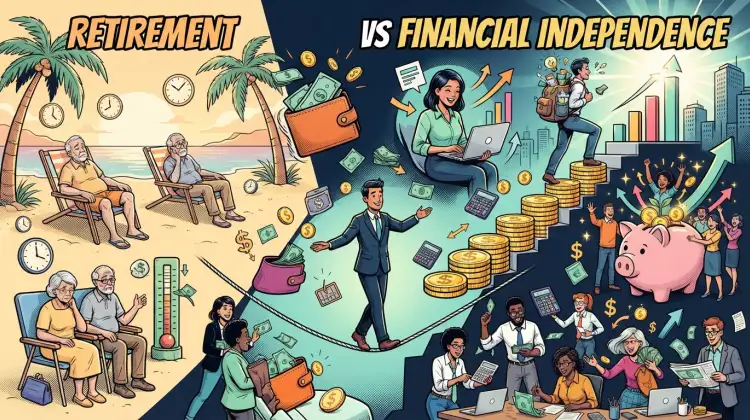
Most people use "financial independence" and "retirement" interchangeably, but they describe two different milestones. Retirement typically means you have stopped working, often because you have reached a certain age. Financial independence (FI) means your assets generate enough income to cover your living expenses, so work becomes optional rather than mandatory. Understanding the distinction can change how you save, invest, and plan the next few decades of your life.
The Core Difference: Age vs. Assets
Retirement is traditionally defined by age. In the US, you can claim Social Security as early as 62, though your benefit is reduced. Full retirement age for anyone born in 1960 or later is 67. Medicare eligibility generally begins at 65. Many employer retirement plans, like a 401(k), allow penalty-free withdrawals at 59½. These rules make retirement a calendar event as much as a financial one.
Financial independence is defined by math, not birthdays. The common benchmark is the 4% rule, which suggests you can withdraw about 4% of a diversified portfolio annually with a reasonable chance of it lasting 30 years. That implies you need roughly 25 times your annual expenses saved. If you spend $50,000 a year, your FI number is about $1.25 million. Reach that number at 45, and you are financially independent even if you never formally retire.
Why Financial Independence Gives You More Options
FI is less about quitting work and more about gaining control. Once your portfolio covers your baseline expenses, you can:
- Negotiate for remote work, fewer hours, or a different role
- Leave a job that is harming your health or relationships
- Start a business or side hustle without relying on it for rent
- Take a career break to care for family or retrain
- Volunteer or pursue lower-paying work you find meaningful
This flexibility is sometimes called "coast FI" or "barista FI," where you only need enough income to cover current expenses while your investments grow untouched. The psychological benefit is often larger than the financial one: you stop making decisions from fear.
How Frugality and Side Hustles Accelerate Both Goals
The same habits that build financial independence also strengthen a traditional retirement. Because your FI number is based on expenses, every dollar you trim from your budget lowers the target. Cutting $500 a month in recurring costs reduces your annual spending by $6,000 and your FI number by roughly $150,000 at a 4% withdrawal rate.
Side hustles work from the other direction. Income from freelancing, tutoring, driving, or selling handmade goods can be funneled into tax-advantaged accounts. For 2025, you can contribute up to $23,500 to a 401(k) and $7,000 to an IRA, with a $1,000 catch-up contribution if you are 50 or older. If you are self-employed, a SEP IRA or Solo 401(k) may allow much higher limits. Automating these contributions turns extra income into long-term security rather than lifestyle creep.
Planning for Health Care and Taxes
Health insurance is the biggest wild card for early retirees in the US. Before Medicare at 65, you need coverage through an employer, a spouse, COBRA, or the Health Insurance Marketplace. Premium tax credits under the Affordable Care Act are based on income, so a low taxable income in early retirement can actually reduce your premiums. This is one reason many FI planners keep a mix of taxable brokerage accounts, Roth accounts, and traditional retirement accounts to manage their reported income year by year.
Taxes also differ. Traditional 401(k) and IRA withdrawals are taxed as ordinary income, while Roth withdrawals are generally tax-free after 59½. Early retirees often use a Roth conversion ladder or 72(t) distributions to access funds before 59½ without penalties. A fee-only fiduciary financial planner can model these scenarios, but the underlying principle is simple: diversify your account types so you have flexibility when you need it.
Which Goal Should You Pursue?
You do not have to choose. Financial independence is the broader goal, and retirement is one possible outcome of it. If you love your work, FI lets you keep doing it on your terms. If you want to stop entirely, FI gives you the means to do so before traditional retirement age. Either way, the path looks similar: spend less than you earn, invest the difference in low-cost index funds, avoid high-interest debt, and let compounding work for decades.
Start by calculating your annual spending, then multiply by 25 for a rough FI target. Compare that to your current savings rate. Even small increases matter: saving an extra 5% of income can shave years off your timeline. Whether you call the finish line retirement or financial independence, the habits that get you there are the same.
The Short Version
Retirement is an age-based milestone tied to Social Security, Medicare, and 401(k) rules. Financial independence is an asset-based milestone where your investments cover your expenses. FI gives you options that retirement alone does not, and it can arrive decades earlier. Frugality lowers your target number, side hustles raise your savings rate, and tax-advantaged accounts do the heavy lifting. Focus on the math, not the calendar, and you will reach whichever milestone you choose.