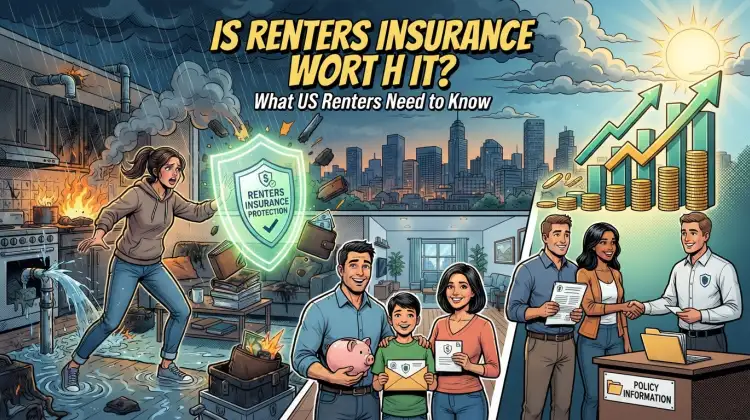
Renters insurance is one of the least expensive insurance policies most Americans will ever buy, yet roughly half of US renters don't have it. The average policy costs about $15 to $20 per month for around $30,000 to $50,000 in personal property coverage, according to the Insurance Information Institute. For that price, the question isn't usually whether renters insurance is worth it in the abstract — it's whether your specific situation, belongings, and landlord requirements make it a smart buy. Here's how to decide.
What Renters Insurance Actually Covers
A standard HO-4 renters policy (the form most US insurers use) covers four main things:
- Personal property: Your furniture, electronics, clothing, kitchenware, and other belongings, both inside your apartment and often while you travel.
- Personal liability: Legal and medical costs if you accidentally injure someone or damage their property — for example, if a guest slips in your kitchen or your bathtub overflows into the unit below.
- Loss of use: Hotel and living expenses if your rental becomes uninhabitable after a covered event like a fire.
- Additional living expenses and medical payments to others: Smaller buckets that cover short-term costs after a covered loss.
What it does not cover: the building itself. Your landlord's policy handles the structure. Renters insurance also excludes floods, earthquakes, and often sewer backups unless you add endorsements. If you live in a FEMA-designated flood zone, you'd need a separate flood policy, typically through the National Flood Insurance Program or a private insurer.
The Real Cost vs. the Potential Loss
Run the math on your own belongings. A typical renter owns $20,000 to $40,000 worth of stuff once you add up a laptop, TV, mattress, sofa, bike, and clothes. Replacing all of that out of pocket after a fire or burglary would be painful.
Two policy structures matter here:
- Actual cash value (ACV): Pays replacement cost minus depreciation. A five-year-old laptop might net you a few hundred dollars.
- Replacement cost value (RCV): Pays what it costs to buy a comparable new item today. It usually adds 10% to 20% to your premium and is generally worth the upgrade.
Also check the deductible. A $500 deductible keeps premiums low but means small claims aren't worth filing. A $1,000 deductible can trim your premium further if you have an emergency fund.
When Renters Insurance Is Clearly Worth It
Several situations tilt the decision toward "yes":
- Your lease requires it. Most US landlords now mandate liability coverage, often $100,000, and may ask to be listed as an interested party.
- You own high-value items. Jewelry, musical instruments, cameras, and collectibles often exceed standard sublimits (commonly $1,500 to $2,500 for jewelry theft). A scheduled personal property endorsement closes that gap.
- You have a dog. Certain breeds are excluded from liability coverage, so confirm your insurer's list before assuming you're protected.
- You work from home. Business equipment like a work laptop or camera may need a home business endorsement.
- You can't easily absorb a total loss. If replacing everything would wipe out your savings, the premium is cheap protection.
When You Might Reasonably Skip It
There are narrow cases where skipping makes sense. If your landlord doesn't require it, you rent a furnished room, and your total belongings are worth under a few thousand dollars, the liability exposure is still the bigger risk — a guest injury lawsuit can run into the tens of thousands. Even then, a liability-only policy is inexpensive. The honest answer is that skipping renters insurance saves a small amount of money while leaving a large, low-probability financial risk unhedged.
How to Get the Best Value
Three practical moves lower your cost:
- Bundle with auto insurance. Multi-policy discounts of 5% to 15% are common, and some insurers offer a standalone renters discount if you're a student or over 55.
- Raise your deductible. Going from $250 to $1,000 can cut premiums meaningfully if you can cover the gap yourself.
- Install safety devices. Smoke detectors, deadbolts, and a security system often earn discounts.
Document your belongings with photos and receipts, and store them in the cloud. Claims go faster when you can prove what you owned.
What to Remember
Renters insurance is worth it for most US renters because it costs roughly the price of a streaming subscription each month while covering two risks that can be financially devastating: losing all your belongings and being sued for liability. The exceptions are narrow. If you rent, check your lease, inventory your stuff, and get at least two quotes — the decision usually takes less time than reading this article.







