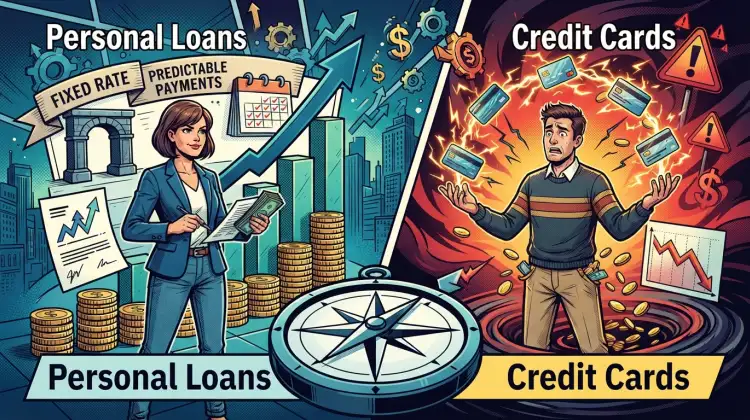
When you need to borrow money, the two most common options for most Americans are a personal loan and a credit card. Both let you access funds you don't have on hand, but they work in fundamentally different ways. A personal loan gives you a lump sum with a fixed repayment schedule, while a credit card gives you a revolving line of credit you can tap, repay, and reuse. Choosing between them affects how much interest you pay, how long you're in debt, and how your credit scores respond. This guide breaks down the personal loans vs credit cards decision so you can match the tool to the job.
How Personal Loans and Credit Cards Differ
A personal loan is an installment loan. You borrow a set amount, typically $1,000 to $50,000, and repay it in equal monthly payments over a fixed term, usually two to seven years. Most personal loans are unsecured, meaning you don't pledge collateral, though some lenders offer secured versions. Because the rate and payment are locked in at origination, you know your total cost upfront.
A credit card is a revolving account. The issuer approves you for a credit limit, and you can borrow against it repeatedly as long as you stay under that limit and make at least the minimum payment. Interest accrues on any balance you carry, and the annual percentage rate (APR) is variable, meaning it can rise or fall with the prime rate. There's no fixed payoff date unless you choose to pay the balance in full or set up a repayment plan.
- Personal loan: fixed rate, fixed term, lump sum, structured payoff.
- Credit card: variable APR, revolving limit, reusable funds, open-ended payoff.
Interest Rates and Total Cost
Rates are the biggest practical difference. According to the Federal Reserve, average credit card APRs have hovered above 20% in recent years, and rates for store cards and subprime borrowers can run considerably higher. Personal loan rates depend heavily on your credit profile. Well-qualified borrowers may see APRs in the 6% to 12% range, while those with weaker credit could pay 25% or more.
The structure matters as much as the rate. A personal loan amortizes, so each payment covers interest and principal, and the balance shrinks on a predictable schedule. A credit card with a 22% APR and a minimum payment of roughly 2% of the balance can take years to repay and cost far more in interest than the original purchase. If you're financing a large, one-time expense and can qualify for a lower personal loan rate, the installment structure usually wins on total cost.
One exception: a 0% introductory APR credit card can beat a personal loan if you can repay the balance before the promotional period ends, typically 12 to 21 months. Miss that deadline, and the regular APR applies to the remaining balance.
When a Personal Loan Makes More Sense
Personal loans tend to be the better fit in several situations:
- Debt consolidation. Replacing several high-rate credit card balances with one fixed-rate loan simplifies your payments and can lower your blended interest rate. Just be aware that closing cards or leaving them open with zero balances affects your credit utilization differently.
- Large planned expenses. Home improvements, medical bills, or a wedding are easier to budget when the payment is fixed.
- You want a payoff deadline. A fixed term forces a clear end date, which helps borrowers who struggle with revolving debt.
- You need a specific sum. If you know exactly how much you need, a loan avoids the temptation to keep spending on a card.
When a Credit Card Makes More Sense
Credit cards have real advantages in other scenarios:
- Short-term cash flow gaps. If you can pay the balance in full each month, you borrow interest-free during the grace period.
- Small or unpredictable purchases. Revolving credit is flexible for expenses you can't forecast.
- Rewards and protections. Cash back, travel points, and fraud liability protections are built into many cards.
- 0% intro offers. A promotional APR can finance a purchase cheaply if you have a firm repayment plan.
The danger is carrying a balance month to month. Once interest compounds at a 20%-plus APR, the cost can quickly outpace a personal loan.
How Each Option Affects Your Credit Scores
Both products influence your FICO and VantageScore credit scores, but through different levers.
A personal loan adds an installment tradeline. Making on-time payments builds positive payment history, the single largest scoring factor. However, a new loan can temporarily lower your score through a hard inquiry and by reducing the average age of your accounts. Because installment debt isn't part of your credit utilization ratio, a loan doesn't directly raise the utilization that revolving debt drives.
Credit cards affect utilization heavily. Utilization is the second-largest scoring factor, and keeping balances below about 30% of your limit, ideally under 10%, helps your scores. Adding a new card also triggers a hard inquiry. Consolidating card debt into a personal loan can lower utilization if you keep the cards open with zero balances, which may offset the new-loan impact over time.
How to Decide
Ask yourself three questions. First, is this a one-time expense or ongoing spending? One-time favors a loan; ongoing favors a card. Second, can you repay the balance within a promotional window or within a month? If yes, a card may be cheaper. Third, what rate can you actually qualify for? Get prequalified quotes from several lenders, which uses a soft inquiry and won't hurt your scores, then compare the APR against your card's rate.
Also weigh the payoff discipline factor. If revolving balances tempt you to pay only the minimum, a fixed-term loan provides structure. If you reliably pay in full, a rewards card is hard to beat.
What to Remember
Personal loans and credit cards solve different problems. Personal loans offer fixed rates, fixed terms, and a clear payoff date, which makes them strong for debt consolidation and large planned expenses. Credit cards offer flexibility, rewards, and interest-free periods when used responsibly, but carrying a balance at a 20%-plus APR gets expensive fast. Compare the actual rate you qualify for, consider how each affects your credit utilization and payment history, and match the borrowing tool to the timeline and discipline of your situation.







